

There are two pieces of advice that get handed to people recovering from serious harm, and both of them, in their own way, make things worse.
The first is: just let it go. The second is: you will never really recover, so you had better learn to live with it. They sound like opposites. One is relentlessly positive, the other grimly resigned. But they share a hidden assumption, and that assumption is wrong. Between them they capture almost everything I think is misunderstood about healing from trauma, which is why I want to take them apart.
Why “just let it go” fails the people who most need help
Let it go is excellent advice for a stubbed toe. It is fine for a missed bus, a rude email, a minor disappointment that is taking up more space in your head than it deserves. For the small frictions of ordinary life, the ability to release and move on is genuinely useful.
It is close to useless for real trauma, and often actively harmful.
The instruction to let go assumes that holding on is a choice, and that the person simply needs to decide to stop. But someone carrying genuine trauma is not holding on by preference. The experience is lodged in the nervous system, in the body, in patterns that were laid down for survival and do not respond to a decision to release them. Telling that person to let it go is like telling someone with a broken leg to just walk it off. The advice does not fail because they are not trying hard enough. It fails because it fundamentally misunderstands what is being carried and how it works.
And there is a second cost. When you tell someone to let go of something they cannot let go of, you do not free them. You hand them a fresh failure. Now, on top of the original harm, they carry the sense that everyone else could apparently move on and they cannot, that they are doing recovery wrong, that their inability to release is a personal deficiency rather than a predictable feature of trauma. Let it go, offered to the wrong person at the wrong time, becomes one more thing they are failing at.
Why the opposite advice is no better
The resigned version sounds more realistic, which is what makes it dangerous. You will never recover. It will always be with you. Learn to live with it.
I want to be clear, because this matters to me: there are people walking around who genuinely believe this and who tell others it is true. That recovery from serious trauma is not possible, that the best anyone can hope for is management and containment, that the damage is permanent and the task is merely to accommodate it.
That is not true, and I say that as someone who was held as a house prisoner for years and who is not managing or containing that experience but living well beyond it. Recovery is possible. It may be more complex than anyone wants it to be. It may require real support and real methodology rather than willpower. But permanence is not the honest verdict, and telling people it is forecloses the thing they most need to believe is available.
Both pieces of advice, the positive and the resigned, make the same mistake. They treat the trauma as nothing but a burden. Something to either throw off or carry forever. Neither of them asks the more interesting question.
The rubble and what might be inside it
Here is how I think about it instead.
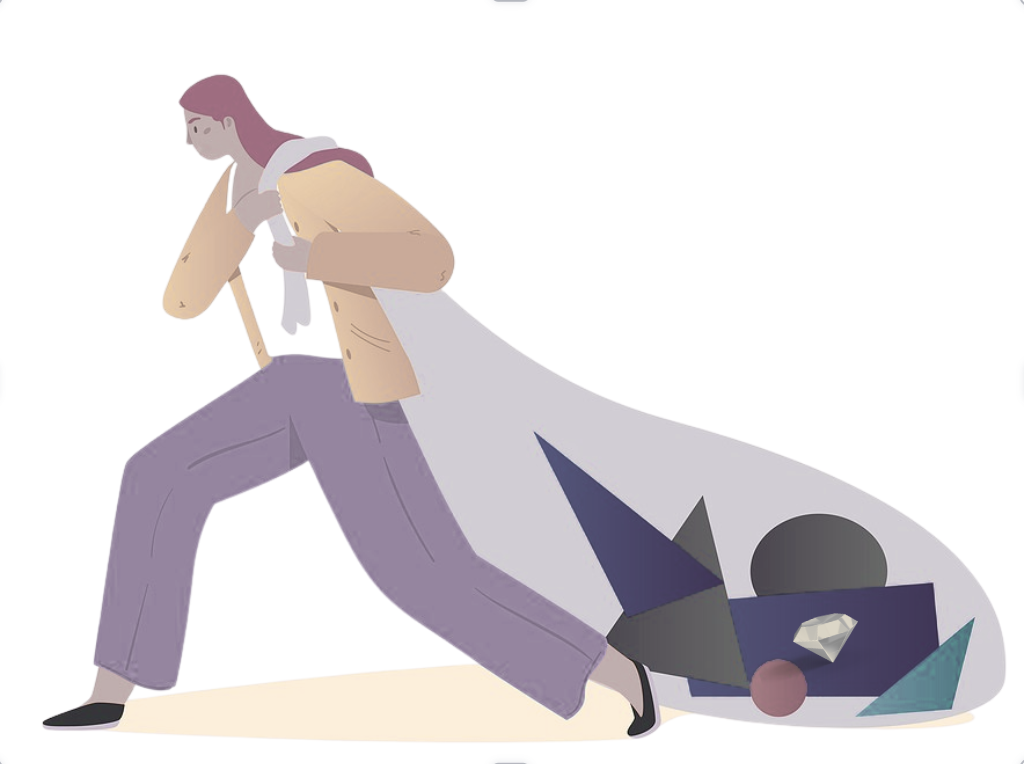
Your trauma is like a sack of rubble. Heavy, awkward, painful to carry, full of sharp and broken things. Everything in the two standard pieces of advice is about the sack itself: put it down, or resign yourself to hauling it forever.
But what if, somewhere in that rubble, there is a diamond?
By which I mean the learning, the meaning, the thing that came out of the experience and that could not have come from anywhere else. I did not want what happened to me. I would not wish it on anyone and I am not going to dress it up as a gift. But I can tell you plainly that the work I now do, the tools I have built, the understanding I can offer other people, all of it came out of that rubble. If I had simply let it go and carried on being an engineer, none of it would exist, and I would not be the person I am now, who is genuinely happier and more useful than the person I might otherwise have been.
That diamond is the reason you cannot just let the sack go. If you throw the whole thing away unexamined, you throw away the diamond with it. And it is also the reason the resigned advice is wrong. If all you ever do is carry the sack, you never dig through it, and the diamond stays buried in there forever, doing nobody any good.
The task is neither to discard the rubble nor to haul it unopened for the rest of your life. The task is to go through it. To find what is in there worth keeping, extract it, and then, only then, set down the rest.
Why you probably need help to find it
This is the part I want to be honest about, because it is where the toxic positivity version does the most quiet damage. Going through the rubble is not something most people can do alone, and the implication that they should be able to is part of what keeps them stuck.
Finding the diamond in a sack of trauma usually takes support, tools, and often a methodology, because the rubble is not neatly sorted and the diamond is not sitting conveniently on top. It is buried in exactly the material that is most painful to handle, which is precisely why people avoid handling it, and why let it go is such a tempting instruction. It gives permission to not look.
But you cannot extract meaning from an experience you refuse to examine, and you cannot examine the most painful material without help holding it while you do. That is not weakness. That is the nature of the task. The people who recover well are, almost without exception, the people who had support to go through the rubble rather than being told to drop it or carry it in silence.
So when someone hands you either version of the standard advice, you are allowed to decline both. You do not have to let it go. You do not have to accept that it will always own you. You get to do the slower, harder, more rewarding thing: go through what you are carrying, find the diamond that is genuinely in there, keep it, and put the rest down at last. That is not letting go. It is something much better. It is recovery.