
We seem to have entered the great AI backlash.
Two years ago the dominant conversation was that AI was amazing” A miracle! It will change everything! Just look what this can do. The mood now is a little different. AI uses too much water. AI takes jobs. AI destroys creativity. AI produces slop. AI stops us thinking. AI art steals from artists. Using AI means you are cheating.
And the em dash has apparently become the typographical equivalent of a demonic summoning.
What interests me is not whether each of these criticisms is right. Some are important. Some are exaggerated. Several are reactions to genuinely terrible uses of AI rather than to AI itself.
What interests me is the pattern, because we have been here before.
Not exactly here. AI has characteristics no previous technology had. But every sufficiently disruptive technology seems to travel through a remarkably familiar cultural cycle. The personal computer did it. The internet did it. The smartphone did it. Cars did it. Industrialisation certainly did it.
Heck – even scribes said the printing press was terrible – on printed pamphlets – Oh the irony!
When I started looking properly at the research on technology adoption, moral panics and technological revolutions, the backlash stopped looking like a referendum on whether AI has worked. It started looking like part of the process by which a technology becomes integrated into a society.
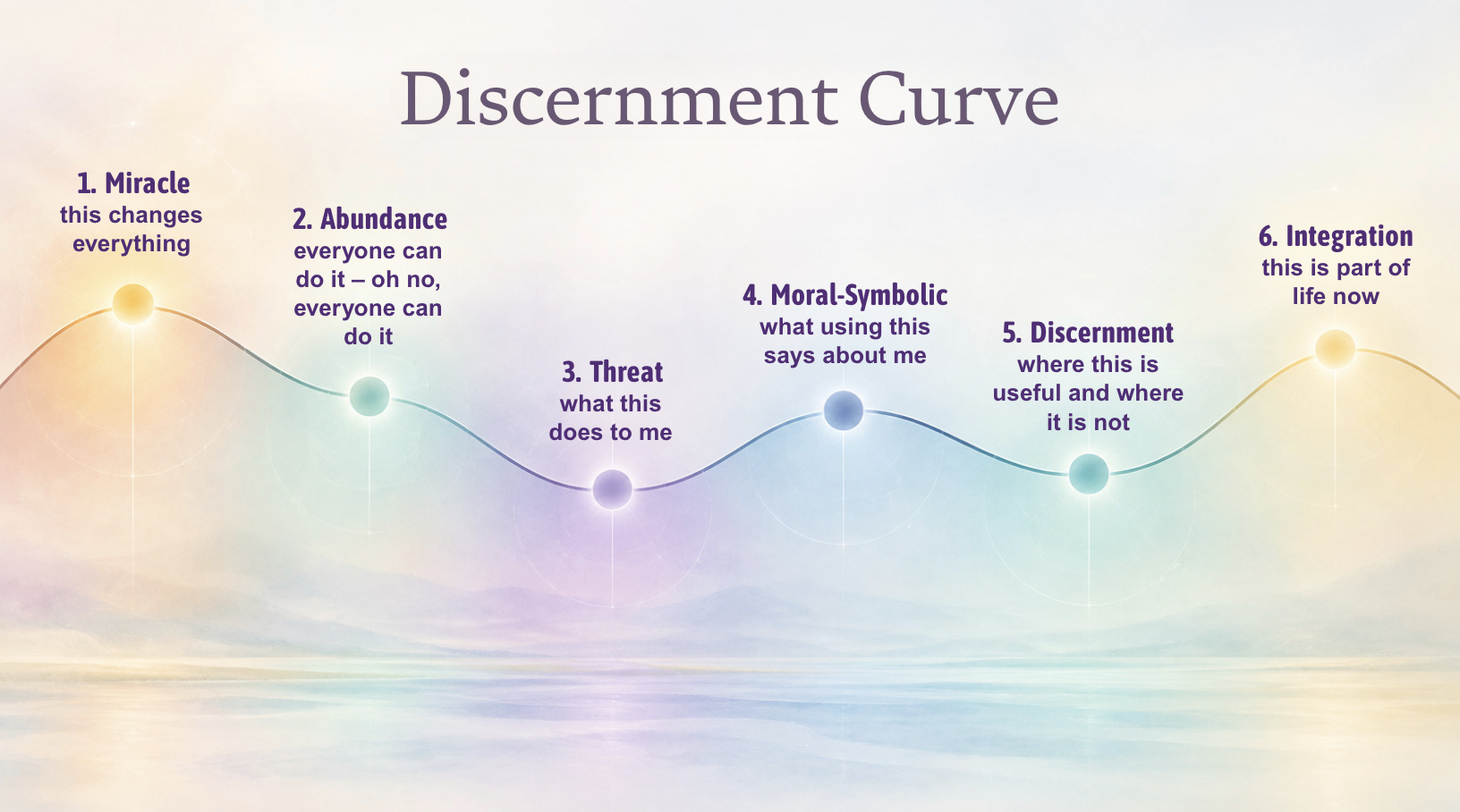
I think that process has six stages, which I’m calling “the Discernment Curve”
STAGE ONE: THE MIRACLE
New technologies arrive through their possibilities.
The personal computer would democratise computing. The internet would democratise information. Social media would democratise publishing. AI would democratise intelligence, creativity and expertise.
At this stage we meet a technology through its best examples, because the people using it are disproportionately curious, capable and willing to experiment. Capability becomes the story, and the only question anybody asks is what this could make possible.
That was the AI conversation from the arrival of ChatGPT onwards. Write software in seconds. Teach any subject. Analyse enormous quantities of information. Give one person the capabilities that used to require a team.
It genuinely was astonishing. Then the technology got easier, and something else happened.
STAGE TWO: ABUNDANCE, AND THE PROBLEM WITH ABUNDANCE
This stage explains more of the current backlash than anything else, and it is the one most often missed.
Technology becomes accessible enough that production explodes. At first, democratisation feels entirely positive. Everyone can publish. Everyone can make images. Everyone can write. Everyone can make a video.
Then we discover the other half of that sentence. Everyone can publish. Everyone can make images. Everyone can write.
The cost of producing material collapses far faster than judgement, taste, skill or restraint develop. Supply explodes and quality does not keep pace, which is where we get generic articles, endless synthetic images, automated posts, AI-generated books and video with no discernible human point of view behind it.
The problem is not that AI produces bad work. Humans have always produced bad work. The difference is that generative AI radically reduces the cost of producing enormous quantities of it.
So the scarcity moves. Before generative AI, the scarce resource was very often the ability to produce at all. Now the scarce resources are judgement, taste, attention, selection and discernment.
None of this is unprecedented. Printing created a flood of books and pamphlets. Desktop publishing let almost anyone design. Digital photography removed the cost of one more photograph. Blogs removed the publishing gatekeeper and YouTube removed the broadcasting one. Every time the barrier to creation collapses, the first result is not a golden age. First comes abundance. Then we have to work out what deserves attention.
STAGE THREE: WHAT DOES THIS DO TO ME?
Eventually a technology stops being an interesting thing happening elsewhere and starts affecting your profession, your income, your status, your children.
The question changes. It is no longer what can this do. It becomes what does this do to me.
Most of the legitimate concerns about AI sit here. What happens to illustrators, translators, junior programmers, teachers, musicians? What happens to education when students can generate essays? What happens to truth when convincing synthetic media costs nothing? Who owns the training data, who receives the productivity gains, and who loses power?
These are not silly questions, and it is worth remembering how badly we tend to caricature this stage afterwards. The Luddites are usually described as people frightened of machines. Much of their resistance was actually about how machinery was being used to change working conditions, weaken skilled labour’s bargaining position and transfer economic value from one group to another.
The same distinction matters now. Opposing a particular deployment of a technology is not the same as opposing technology. Sometimes resistance is a society beginning to notice costs that were invisible while everyone was still dazzled.
STAGE FOUR: WHAT DOES USING THIS SAY ABOUT YOU?
This is where I think we currently are, and it is the strangest stage of the six.
A technology stops being merely useful or dangerous and becomes symbolic. Using it starts to say something about what kind of person you are.
So the conversation shifts. From “AI sometimes produces weak writing” to “if you use AI, you can’t write.”
From “AI images raise real copyright and labour questions” to “if you use AI images, you don’t care about artists.”
From “AI can reduce cognitive effort” to “using AI means you have stopped thinking.”
Moral judgement attaches itself not to the outcome but to the presence of the technology. And because nobody can reliably detect AI use, people start hunting for markers. Certain phrases. Certain sentence structures. Certain visual aesthetics. And, apparently, punctuation.
What is happening underneath is more interesting than the punctuation. A society is trying to police a boundary, and the boundary is what still counts as authentically human.
That question has unusual force with generative AI, because AI has moved into territory we have always associated with human interiority. Language, art, reasoning, imagination, companionship. Previous technologies mostly amplified physical capability. This one interferes with the things we have used as evidence that there is a mind behind the work.
Which makes the backlash partly existential. If a machine can produce something that looks like writing or thought, what makes human writing and thought valuable? That is not a technology question. It is an identity question.
And this stage does something necessary, however uncomfortable it is to live through. It sets boundaries. Some of them will look ridiculous in five years. Some will quietly disappear. Others will become norms we take entirely for granted: disclosure where impersonation is possible, human oversight in certain professions, conventions within particular creative communities about what assistance is acceptable.
The backlash is not evidence that adoption is failing. It may be the mechanism by which a society decides which uses it will accept.
STAGE FIVE: WHERE IS THIS USEFUL, AND WHERE IS IT NOT?
Eventually the question of whether AI is good or bad becomes obviously inadequate, because AI is not one activity.
Using AI to transcribe a meeting is not the same as generating a novel and claiming you wrote it. Using it to explore a hundred engineering possibilities is not the same as accepting a structural calculation without checking it. Using it to challenge your reasoning is not the same as asking it to do your thinking.
Mature technology cultures develop distinctions, and this is where I think we are beginning to move.
The useful questions become where AI helps, where it is inappropriate, what requires supervision, what should never be delegated, what requires disclosure, and what competent use actually looks like.
Underneath all of those sits one question that I suspect will define the next stage: how much human agency remains in the process?
Some AI use has very low agency. Write me a hundred posts. Generate fifty articles. Make something impressive. The human has effectively withdrawn.
Other uses have high agency. Here is my argument, here is my evidence, challenge my assumptions, find the weaknesses, give me alternatives I have not considered.
The technology is present in both. The intellectual activity is entirely different.
Which suggests the dividing line of a mature AI culture will not be AI versus human. It will be high-agency collaboration versus low-agency automation.
STAGE SIX: THIS IS PART OF LIFE NOW
Successful technologies eventually become boring.
Nobody announces that they are using digital technology when they write in Word. Nobody marvels at satellite navigation on the way to dinner. The technology disappears into the activity.
That does not mean every use is accepted. We integrated cars and then built driving licences, traffic lights, speed limits, seatbelts and drink-driving laws. Integration is not permission. It means we have developed enough legal, cultural and practical structure that we no longer have to treat the whole thing as one enormous moral question.
AI will probably arrive somewhere similar. Some uses regulated, some socially unacceptable, some commercially dead, and a great many so ordinary that within a decade we will barely think of them as AI at all.
And the question will change from “did you use AI” to “was this any good.” Was it accurate. Was it original. Was there judgement in it. Is anybody accountable for it.
That is what technological maturity looks like.
SO WHERE ARE WE?
Somewhere in the late threat stage, deep in the moral and symbolic one, with the earliest signs of discernment appearing at the edges.
The abundance problem is everywhere. The economic threat is real. But the cultural conversation has become overwhelmingly moral, and AI is no longer only something people evaluate. It has become something people use to evaluate each other. You use AI, therefore you are lazy. You do not use AI, therefore you are authentic.
Those are classic signs of a technology in its boundary-setting phase.
At the edges, though, something better is starting. People are beginning to say that it depends. It depends what you are using it for. It depends how much judgement stays with the human. It depends whether you understand the output. It depends whether you are replacing expertise or extending it.
That is discernment, and it is where the curve turns.
The most useful thing I can offer about the backlash is this. It is not a detour from adoption. It is one of the ways a society learns to adopt something.
Enthusiasm drives the experiment. Abundance exposes the failure modes. Threat makes us notice the consequences. Moral resistance forces us to negotiate our values. Discernment separates the useful applications from the stupid ones. Integration keeps whatever survives.
So the great AI backlash may not be the end of anything. It may simply be the point at which we stop being dazzled by what the technology can do, and start working out what we actually want to do with it.