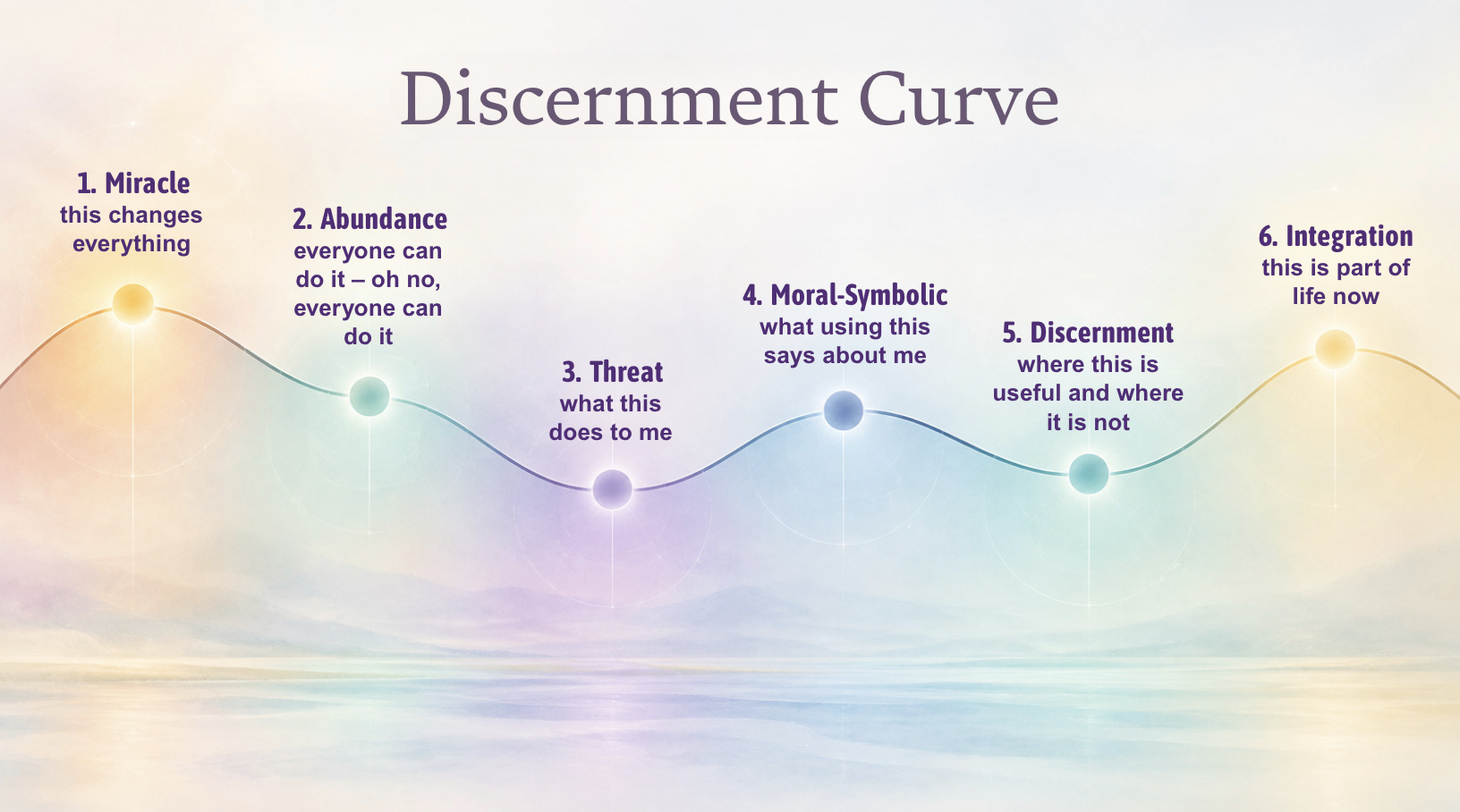


Ask a room full of experienced coaches and therapists a simple question. Of your most stuck clients, how many were stuck because they could not see their pattern? Almost no hands go up. The stuck client is rarely the unaware one. More often she is the most self-aware person in her own life, able to narrate her wounding with a fluency her friends and family cannot match. She knows the scene. She knows the belief. She knows which parent, which decade, which sentence. And she is still living inside the very thing she can describe so well.
This is one of the most quietly disorienting experiences in practitioner work, because everything in our training points the other way. So much of the field treats insight as the active ingredient. If we can just help the client see the story running underneath, name the belief, locate the origin, then change is supposed to follow. Sometimes it does. Often it does not. And the gap between seeing and changing is where a great deal of good work quietly stalls.
Two assumptions worth challenging
Underneath most methods in this space sit two assumptions that are so common they are rarely examined. The first is that awareness is most of the work, that if a client can see the pattern clearly enough, the seeing will loosen it. The second is that to change an old wound you must go back to it, revisit the originating memory, and process it again, sometimes vividly, sometimes painfully.
I want to challenge both, not because the practitioners who hold them are careless, but because the assumptions are so rarely put under any pressure. Awareness is extraordinary and necessary. It is the map. It shows you the terrain, names the features, tells you where the difficulty lives. But a map is not the territory, and reading it accurately has never yet moved a mountain. I have watched clients hold the most precise, well-drawn map of their own pattern and remain exactly where they started, because the map was never the thing that needed to change. The territory was.
The second assumption, that you must return to the wound, deserves even closer inspection, because it is where a lot of avoidable pain enters the room. Many of the fastest, most confident methods in this field are built on regression. The premise is that you find the originating scene, go back into it, and rework it there. For some people this is tolerable. For the high-functioning client with a well-defended history, being marched back into the memory can be re-activating rather than freeing, and it quietly teaches the nervous system that the material is dangerous enough to require a descent every time.
What memory science actually suggests
Here is where the science is genuinely encouraging, and where it diverges from both assumptions at once. Research into memory reconsolidation, first demonstrated in the laboratory around the turn of the century and since developed into a described therapeutic process, indicates that an emotional learning is not permanent. When an old interpretation is activated under particular conditions, there appears to be a window in which the learning itself can be revised rather than merely suppressed or countered with a competing belief.
The important detail for practitioners is what this does and does not require. It does not require the person to relive the event in full sensory detail. It does not require years of graded exposure. What it points to is that the interpretation, the meaning the younger self assigned to the event, is the thing that can be updated, and that once it is updated the old emotional response does not need to be managed because it is no longer being generated. This is a very different picture from both the regression route and the see-your-story route. It suggests the wound does not have to be re-entered, and that awareness of the pattern, while useful for locating it, is not the mechanism that removes it.
Seeing, then removing
This is the distinction I would most want a thoughtful practitioner to carry away. Awareness locates the pattern. It is the map, and you cannot clear what you cannot find, so the map matters. But locating is not removing. After the client has seen the interpretation clearly, there is a separate act, and it is the one most methods leave out. The interpretation has to be dissolved, across the whole timeline where it has been operating, not just in the single scene where it began and not by asking the client to relive anything.
When that happens, the change does not announce itself dramatically. The client tends to describe it almost in passing. She notices weeks later that a situation which used to reliably light her up simply did not. There was no heroic act of regulation, no bracing, no return to the memory. The charge was gone, so the situation had nothing to catch on. That flatness, the absence of a reaction that used to be automatic, is what clearing actually looks like from the inside.
If your work brings you the client who understands her pattern perfectly and lives it anyway, you have met the exact place where awareness ends and clearing begins. reCET, CET and the CET practitioner training are built around that specific transition, the move from an accurate map to a removed pattern, and around doing it without sending anyone back into the wound to get there.